
Women’s Sober Living in Houston: A Complete Guide for Women in Recovery
Finding the right recovery environment can make a meaningful difference during the transition from addiction treatment to independent living. Hope House is the Women’s sober living Houston options provide women with a substance-free, structured place to live while they continue building healthy routines, strengthening recovery skills, and reconnecting with everyday life.
For many women, recovery is about more than stopping substance use. It can involve rebuilding confidence, repairing relationships, establishing boundaries, returning to work or school, managing responsibilities, and learning how to handle stress without turning back to substances.
A well-designed recovery residence can provide the stability and accountability needed during that transition.
At Winds of Change Recovery, Hope House is a women-only sober living home in Houston designed to bridge the gap between clinical treatment and independent living. The program emphasizes structure, accountability, community, trauma-informed care, and continued connection to clinical support.
What Is Women’s Sober Living Houston?
Hope House Women’s sober living Houston refers to recovery residences in the Houston area designed specifically for women who are working toward continued sobriety.
A sober living home is different from a hospital or traditional residential treatment facility.
The primary purpose is usually to provide a safe, substance-free and supportive living environment where residents can practice recovery in everyday life.
Depending on the residence, women may have access to:
- Structured daily routines
- House rules and accountability
- Peer support
- Recovery meetings
- Transportation assistance
- Connections to outpatient treatment
- Case management or recovery coaching
- Employment and educational support
- Wellness activities
- Continued clinical coordination
The specific services differ from one residence to another, so women and families should evaluate the actual program rather than choosing a residence based only on the words «sober living.»
Why Choose Sober Living for Women?
Women can face recovery challenges that are influenced by relationships, trauma, parenting responsibilities, safety concerns, family dynamics, and other life circumstances.
That is one reason some women prefer a gender-specific recovery environment.
Sober living for women can provide a community in which residents share the experience of rebuilding their lives alongside other women in recovery.
A women-only environment may also give residents the opportunity to discuss experiences that they may feel uncomfortable discussing in a mixed-gender setting.
The benefit isn’t simply that everyone is female.
The greater benefit can come from creating a community built around safety, accountability, shared experience, and recovery-focused relationships.
What Is a Women’s Sober Living Home Like?
A women’s sober living home should feel more like a supportive home than a clinical institution, while still maintaining clear expectations designed to protect the recovery environment.
Residents typically live together and share certain household responsibilities.
Depending on the residence, daily life may include:
Morning routines:
Getting ready for work, school, appointments, therapy, or other responsibilities.
Recovery activities:
Attending support meetings, counseling, outpatient treatment, or other recovery services.
House responsibilities:
Completing chores, maintaining personal spaces, and participating in community responsibilities.
Employment or education:
Working, attending school, volunteering, or participating in an approved structured activity.
Evening routines:
Returning by curfew where applicable, attending meetings, preparing meals, relaxing, and preparing for the next day.
This combination of freedom and accountability can help residents practice the skills they will eventually need to maintain recovery independently.
Who Is Women’s Sober Living For?
Women’s sober living is generally designed for women who are sufficiently stable to live in a structured community while continuing their recovery.
At Winds of Change’s Hope House, the current program describes eligibility for women age 18 and older who are medically stable, do not require detox, are actively participating in recovery, therapy, or outpatient treatment, want additional accountability before returning to independent living, and are committed to maintaining a substance-free lifestyle.
That means sober living may be appropriate for someone who:
- Has completed residential or inpatient treatment
- Is participating in outpatient treatment
- Is transitioning from a higher level of care
- Needs a stable sober environment
- Wants additional accountability
- Is rebuilding independent living skills
- Wants to live around other women committed to recovery
It may not be appropriate for someone who currently requires medical detox or a higher level of medical or psychiatric care.
A professional assessment can help determine the appropriate level of support.
Can You Go From Rehab to Women’s Sober Living?
Yes.
For many people, the transition from treatment to independent living is one of the most vulnerable stages of recovery.
A person may have achieved important progress in treatment but still face the same triggers, stressors, relationships, neighborhoods, and routines that existed before treatment.
Returning immediately to that environment can be difficult.
A structured recovery residence can provide a transition period in which a woman can:
- Continue therapy
- Attend outpatient treatment
- Build sober routines
- Return to work
- Reconnect with family
- Practice financial responsibility
- Develop healthy relationships
- Strengthen relapse-prevention skills
- Prepare for independent housing
Winds of Change specifically positions Hope House as a bridge between clinical treatment and independent living, with residents continuing to participate in recovery activities while developing greater stability and independence.
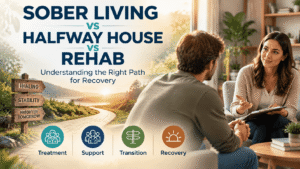
What Is the Difference Between Women’s Sober Living and Rehab?
This is an important distinction.
Rehab provides treatment.
Sober living provides recovery-supportive housing.
A residential treatment program is structured around clinical care. Residents live at the program while receiving treatment according to their level of care.
A sober home is primarily a living environment.
A resident may attend therapy, IOP, medical appointments, or support meetings outside the home while returning to a substance-free residence.
This means a woman doesn’t necessarily have to choose between treatment and sober living.
In some situations, the two can work together.
For example:
Morning: Work or school
Afternoon: Outpatient treatment or therapy
Evening: Recovery meeting and return to sober living
This creates an opportunity to practice recovery while gradually returning to real-world responsibilities.
What Rules Are Common in Women’s Sober Living?
Rules vary by residence, but structure is an important part of recovery housing.
Common expectations may include:
No Alcohol or Illicit Drugs
Residents are expected to maintain a substance-free environment.
Curfews
Some homes establish curfews to create consistency and accountability.
Drug or Alcohol Testing
Some recovery residences use random testing as part of their accountability model.
Employment, School, or Structured Activity
Residents may be expected to work, attend school, volunteer, or participate in an approved recovery activity.
House Meetings
Community meetings may provide opportunities to discuss concerns, responsibilities, and progress.
Chores
Residents generally share responsibility for maintaining the home.
Visitor Policies
Rules around visitors can help protect safety, privacy, and the recovery environment.
These rules are not designed to punish residents.
They exist to create predictable boundaries in an environment where sobriety is the priority.
Why Is Structure Important in Early Recovery?
Early recovery can be unpredictable.
Without structure, a person may return to patterns associated with substance use simply because those patterns are familiar.
A daily routine can help create consistency around:
- Sleep
- Meals
- Work
- Therapy
- Exercise
- Meetings
- Personal responsibilities
- Social activities
Structure can also reduce the amount of time spent isolated or making decisions in environments that may increase the risk of returning to substance use.
The goal is not permanent supervision.
The goal is to gradually build the ability to manage life independently.
What Makes a Good Women’s Sober Living Program?
Not every recovery residence offers the same level of support.
When comparing women’s sober living programs in Houston, pay attention to what happens beyond the marketing language.
Ask:
Is the home genuinely substance-free?
Who supervises the residence?
What are the house rules?
What happens after a relapse?
Are residents required to participate in treatment or recovery activities?
Can residents work or attend school?
How is transportation handled?
Are mental-health needs addressed?
Can residents continue prescribed medications?
Are families and treatment providers included when appropriate?
What are the costs and what do they include?
How does the transition to independent housing work?
A transparent program should be able to answer these questions clearly.
Why Women-Only Recovery Housing Can Matter
A gender-specific environment can create a different social dynamic from a mixed-gender setting.
Women may feel more comfortable discussing:
- Trauma
- Relationships
- Parenting
- Family responsibilities
- Boundaries
- Self-esteem
- Abuse
- Grief
- Shame
- Recovery challenges
This does not mean women cannot recover successfully in co-ed environments.
It simply means some women may find that a women-only setting provides the sense of safety and community they need at a particular stage of recovery.
Houston has multiple forms of women-focused recovery housing, ranging from recovery residences to transitional and supportive housing programs with different missions and eligibility requirements.
Women’s Sober Living and Trauma-Informed Recovery
Trauma can be an important consideration in addiction recovery.
Some women entering recovery may also be dealing with unresolved trauma, PTSD symptoms, anxiety, depression, or difficult relationship experiences.
A trauma-informed recovery environment recognizes that safety, trust, choice, empowerment, and emotional well-being matter.
At Hope House, Winds of Change describes its approach as trauma-informed and emphasizes compassionate accountability, whole-person healing, and connection to the clinical team.
A sober living home does not necessarily provide trauma therapy itself.
However, a residence can support trauma recovery by creating a stable environment in which residents are able to continue appropriate clinical care.
Can You Work While Living in Sober Living?
In many programs, yes.
Employment can be an important part of rebuilding independence.
Working can help women:
- Establish routine
- Increase financial independence
- Rebuild confidence
- Develop responsibility
- Create purpose
- Save for future housing
- Develop healthy social connections
Some residents may instead attend school, vocational training, or another approved program.
The specific expectations depend on the residence.
The objective is usually to encourage productive, recovery-supportive activity rather than keeping residents disconnected from everyday life.
Can You Attend Outpatient Treatment While Living in a Sober Home?
Yes, and this combination can be particularly useful for some women.
A resident may live in sober housing while participating in:
- Individual therapy
- Group therapy
- Intensive Outpatient Program (IOP)
- Medication management
- Family counseling
- Recovery meetings
- Case management
- Other clinically appropriate services
Hope House is specifically designed to remain connected to clinical care, with transportation to therapy and recovery meetings and coordination with therapists and treatment providers listed among its program features.
This allows residents to practice recovery in a structured home while continuing professional support.
Is Women’s Sober Living Covered by Insurance?
This depends on the residence and the specific service involved.
Sober living is generally a housing service rather than the same thing as a billable clinical treatment program.
Insurance coverage for clinical services such as therapy or IOP may be separate from housing costs.
Before moving in, ask the residence:
- What is the total monthly cost?
- What does the fee include?
- Are there additional charges?
- Is treatment billed separately?
- Does insurance cover any associated clinical services?
- What deposits are required?
- What happens financially if a resident leaves early?
Getting the complete cost in writing can prevent unpleasant surprises.
How Long Can Women Stay in Sober Living?
There is no universal timeline.
Some women may need only a few months of structured housing.
Others may benefit from a longer transition period.
Length of stay can depend on:
- Recovery progress
- Stability
- Employment
- Housing availability
- Treatment needs
- Financial circumstances
- Program rules
- Individual goals
The goal should be progress toward sustainable independence—not simply meeting an arbitrary move-out date.
What Happens After Sober Living?
Sober living is not supposed to be the final destination.
Ideally, residents gradually build the foundation for independent life.
That might include:
Step 1: Stabilize
Establish sobriety and a healthy daily routine.
Step 2: Participate
Continue treatment, work, school, meetings, and recovery activities.
Step 3: Build confidence
Practice handling responsibilities, relationships, finances, and stress.
Step 4: Prepare
Identify long-term housing, employment, continuing-care, and recovery-support resources.
Step 5: Transition
Move into more independent housing while maintaining recovery supports.
A successful transition means taking the skills developed in sober living into the next stage of life.
How Families Can Support a Woman in Sober Living
Families often have an important role in recovery, but support doesn’t mean trying to control every part of the process.
Helpful family support may include:
- Respecting healthy boundaries
- Encouraging continued treatment
- Avoiding shame and criticism
- Learning about addiction
- Participating in family counseling when appropriate
- Celebrating progress
- Encouraging healthy routines
- Supporting independence
It can also be helpful for family members to remember that recovery is a process.
There may be difficult days even when someone is making meaningful progress overall.
Signs That a Woman May Need More Support
Sober living is designed to support recovery, but sometimes a person needs a higher level of care.
Warning signs may include:
- Returning to frequent substance use
- Severe withdrawal symptoms
- Major changes in mental health
- Suicidal thoughts
- Repeated inability to follow safety expectations
- Significant medical problems
- Inability to function safely in the community
In these situations, the appropriate response may be increased clinical support rather than simply adding more house rules.
A qualified treatment professional can help determine whether the current level of care is still appropriate.
What Makes Houston a Practical Location for Recovery?
Houston’s size can provide access to a broad range of treatment, medical, behavioral-health, employment, educational, and recovery-support resources.
For a woman living in sober housing, being connected to the broader community can make it easier to gradually rebuild everyday life.
A recovery plan may involve combining housing with:
- Outpatient addiction treatment
- Mental-health counseling
- Employment
- Education
- Recovery meetings
- Family support
- Medical care
- Community resources
The right residence should therefore be evaluated not only as a house, but as part of a larger recovery ecosystem.
Why Hope House May Be the Right Next Step for Some Women
Winds of Change Recovery’s Hope House is a women-only sober living home in Houston designed for women who are medically stable, committed to a substance-free lifestyle, and actively participating in recovery or treatment.
The program describes a structured environment with daily accountability, shared accommodations, meals, transportation to therapy and recovery meetings, coordination with clinicians, recovery coaching, case management, and wellness activities.
The residence is positioned as a bridge between treatment and independent living rather than a substitute for detox or acute medical care.
That distinction matters.
Someone who needs detox needs detox.
Someone who requires residential clinical treatment needs an appropriate treatment program.
Someone who is medically stable and ready to practice recovery with additional structure may benefit from recovery housing.
Frequently Asked Questions About Women's Sober Living Houston
Women’s sober living Houston refers to recovery residences in Houston designed specifically for women who want to maintain sobriety while living in a structured, supportive, substance-free environment.
Eligibility varies by residence. Programs may require residents to be adults, medically stable, committed to sobriety, and actively participating in treatment or recovery activities. Hope House, for example, lists women 18 and older who are medically stable and actively participating in recovery, therapy, or outpatient treatment among its intended residents.
No. Rehab is a treatment service, while sober living primarily provides a recovery-supportive living environment. A woman may use sober living while continuing outpatient treatment.
Many programs allow or encourage residents to work, attend school, volunteer, or participate in another structured activity. Individual house rules determine what is permitted.
Some residences coordinate therapy or connect residents with outside treatment, but sober living itself is not necessarily a clinical treatment facility. Ask exactly which clinical services are included.
The length of stay varies. Some women stay for several months, while others need a longer transition period based on their recovery and housing needs.
Yes. Many women combine sober living with outpatient treatment, including IOP, when clinically appropriate.
Safety depends on the residence’s policies, staffing, environment, substance-free standards, emergency procedures, and oversight. Families should ask detailed questions before choosing a home.
Not necessarily. Admission requirements vary, and some programs accept women at different stages of recovery. The key issue is whether the woman can safely participate in that residence’s structure.
Look for transparent policies, a genuinely substance-free environment, appropriate supervision, reasonable house rules, recovery support, connections to treatment, clear costs, and a defined pathway toward greater independence.
Take the Next Step Toward Recovery
Choosing women’s sober living Houston isn’t simply a decision about where someone will sleep.
It’s a decision about where she will rebuild.
The right environment can provide stability when life still feels uncertain, accountability when motivation changes, community when isolation feels easier, and support while a woman learns to navigate everyday life in recovery.
For women who have completed or are participating in treatment and need a structured bridge toward greater independence, a supportive sober living home can be an important part of the recovery journey.
At Winds of Change Recovery, Hope House provides a women-only, structured recovery environment in Houston designed to support women as they move from treatment toward independent living.
Recovery is not about having everything figured out.
It’s about taking the next healthy step—and continuing to build from there.