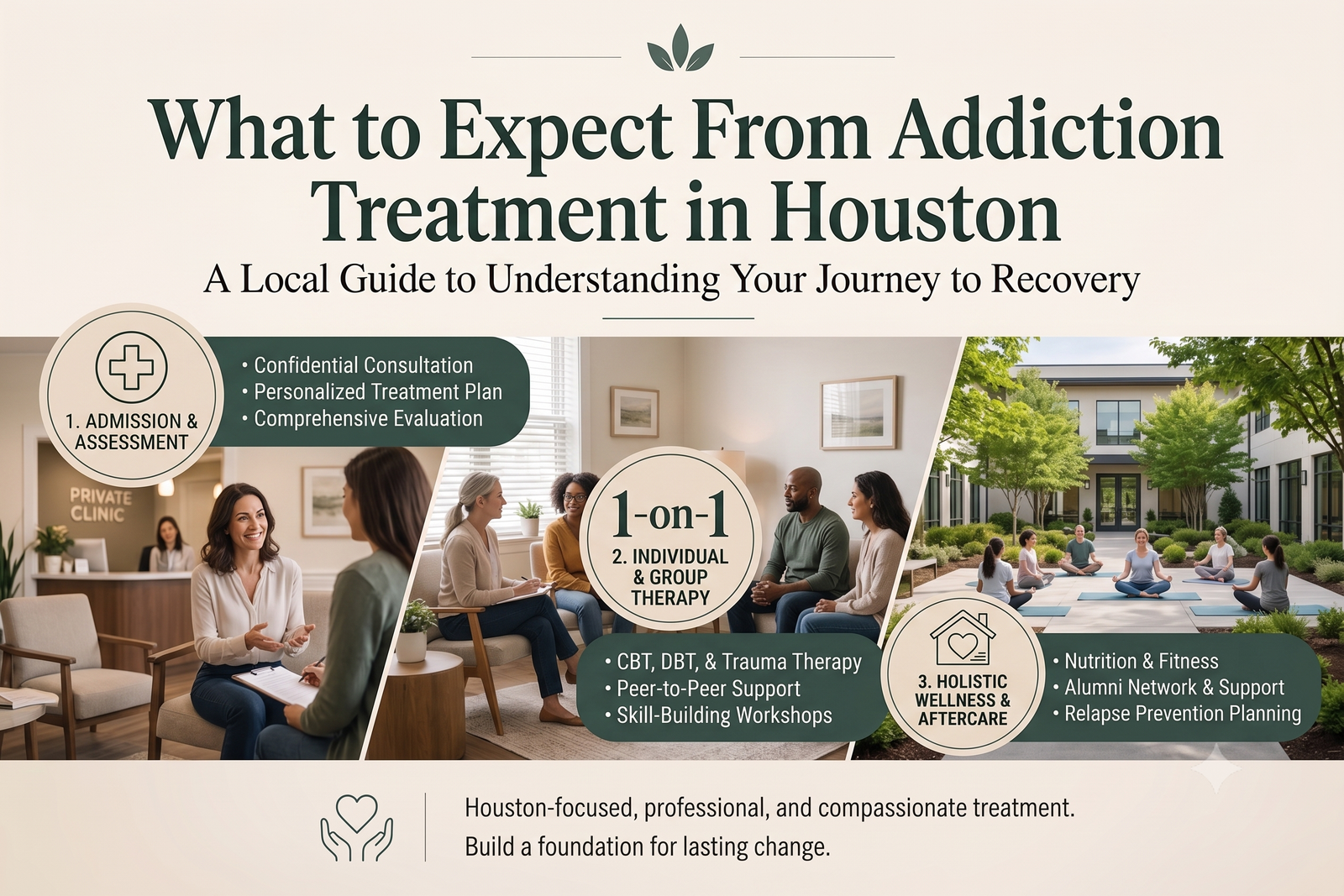
Choosing to seek help for drug or alcohol use can feel overwhelming, especially when you do not know what will happen after you make the first call. Understanding the process can make that first step feel more manageable. Addiction treatment in Houston can involve assessment, individualized counseling, group therapy, family support, recovery planning, and—when clinically appropriate—referral or coordination for a higher level of care.
The important thing to remember is that treatment is not supposed to be a one-size-fits-all experience. Your medical history, substance use, mental health, living situation, previous treatment experiences, goals, and support system can all influence the type and intensity of care that is appropriate.
For people in Houston, the surrounding communities, or areas such as Conroe and The Woodlands, knowing what to expect can help you or a loved one make a more informed decision about getting help.
What Does Addiction Treatment in Houston Usually Look Like?
The treatment process generally begins with an assessment and continues through a personalized plan of care. Depending on a person’s needs, treatment may include outpatient counseling, intensive outpatient services, medication-related care, residential treatment, medically supervised withdrawal management, or other services.
Texas Health and Human Services describes a broad continuum of substance use services that can include screening, assessment and referral, detoxification, residential treatment, outpatient services, medication-assisted treatment, and services for co-occurring psychiatric and substance use disorders.
That means the first question should not simply be, «Which rehab is best?»
A better question is:
«What level and combination of care is appropriate for this person right now?»
Quick answer: What should you expect?
Most people can expect some combination of:
- A confidential initial conversation
- A clinical or behavioral health assessment
- Discussion of treatment goals and history
- Development of an individualized treatment plan
- Individual and/or group counseling
- Family involvement when appropriate
- Skills for managing cravings, triggers, emotions, and relationships
- Progress reviews and adjustments to treatment
- A continuing-care or aftercare plan
The exact process varies by provider and level of care.
What Happens During the First Call?
The first call is often much less intimidating than people imagine.
You may speak with an admissions professional, counselor, or recovery specialist who asks about your current situation. Questions can cover the substance being used, frequency of use, previous treatment, current concerns, mental health history, medications, family circumstances, and what you hope to change.
You do not need to have every answer prepared.
The purpose of the conversation is to understand your situation and determine what next step makes sense. A responsible provider should be willing to explain available services, answer questions, discuss financial or insurance considerations, and tell you when another level of care may be more appropriate.
For example, someone who needs medically supervised withdrawal management should not simply be placed into an outpatient counseling schedule without appropriate clinical evaluation.
SAMHSA notes that treatment options vary and recommends using qualified treatment providers and resources such as FindTreatment.gov when looking for substance use disorder care.
What Happens During an Addiction Treatment Assessment?
An assessment helps the treatment team understand the person behind the substance use.
Depending on the provider and program, the assessment may explore:
- Substance use history
- Physical and behavioral health
- Previous treatment episodes
- Withdrawal history
- Current medications
- Mental health symptoms
- Trauma history
- Family and relationship concerns
- Employment or education responsibilities
- Housing and environmental factors
- Recovery goals
- Existing support systems
The goal is not to judge you. It is to determine what type of care can provide an appropriate level of support.
SAMHSA guidance describes assessment as an important part of understanding a person’s substance use, health, treatment options, and goals before developing a treatment plan.
Why individualized treatment matters
Two people can use the same substance and require very different treatment plans.
One person may need a medically supervised level of care because of withdrawal risk. Another may be medically stable and benefit from structured outpatient counseling while continuing to work and live at home.
That distinction is one reason a quality Houston addiction treatment provider should evaluate the individual rather than simply placing everyone into the same program.
Will You Need Detox Before Treatment?
Not everyone needs detox, and detox is not the same thing as comprehensive addiction treatment.
Detoxification focuses primarily on safely managing withdrawal and helping the body stabilize after substance use. Treatment goes further by addressing the behavioral, psychological, social, and environmental factors associated with substance use.
For some substances and patterns of use, stopping suddenly can create serious medical risks. The appropriate setting for withdrawal management should therefore be determined by qualified medical professionals.
If detox is necessary, a treatment provider may coordinate or refer the person to an appropriate medically supervised program before continuing with counseling or another level of care.
This distinction is important because completing detox does not automatically resolve the underlying substance use disorder.
What Happens During Therapy?
Therapy is often a central part of treatment.
Individual counseling gives you an opportunity to work privately with a qualified professional on issues such as:
- Triggers and cravings
- Stress management
- Emotional regulation
- Relapse prevention
- Relationships
- Trauma
- Grief
- Negative thought patterns
- Communication
- Healthy coping strategies
- Personal goals and values
Group therapy provides another dimension of recovery. Instead of working only one-on-one, participants can learn from shared experiences, practice communication, develop accountability, and recognize that they are not alone.
Evidence-based behavioral approaches can help people develop practical skills for changing patterns associated with substance use. SAMHSA’s current treatment resources also recognize behavioral therapies and medications as important components of substance use disorder care.
What Is an Intensive Outpatient Program in Houston?
An intensive outpatient program Houston residents may consider provides structured clinical support without requiring the person to live at a residential treatment facility.
This can be particularly relevant for people who need more structure than traditional weekly counseling but who are clinically appropriate for outpatient care.
At Winds of Change Recovery, the current intensive outpatient program includes 12 hours per week of group clinical services along with individual and family therapy. The program also provides longer-term recovery planning and resources, including ongoing therapy, psychiatric care, specialty groups, 12-step meetings, and alumni services.
The advantage of outpatient treatment is that eligible clients can work on recovery while remaining connected to daily responsibilities.
However, outpatient treatment is not automatically the right choice for everyone. The appropriate level of care should be determined through an individualized assessment.
What Does a Typical Day in Outpatient Treatment Look Like?
A structured outpatient day or week can include a combination of:
Group therapy:
A facilitated environment where clients explore recovery topics, develop coping skills, and learn from others.
Individual therapy:
Private sessions focused on personal goals, challenges, emotional health, and recovery planning.
Family therapy:
When clinically appropriate, family sessions can help improve communication, boundaries, understanding, and support.
Psychoeducation:
Clients may learn about addiction, triggers, coping strategies, mental health, relapse prevention, and recovery.
Specialty groups:
Some programs offer groups focused on gender, trauma, grief, relationships, emotional regulation, or other recovery needs.
Independent recovery work:
Clients may be encouraged to practice new skills between sessions and participate in appropriate community or peer-support resources.
Winds of Change Recovery currently describes individual and family counseling, specialty groups, psychodrama groups, 12-step meetings, psychiatric care, and alumni services as part of its broader recovery resources.
Can Family Members Be Involved in Treatment?
Yes. Family involvement can be an important part of recovery when it is appropriate and welcomed by the client.
Addiction rarely affects only one person. Substance use can change communication, trust, responsibilities, finances, parenting, and family relationships.
Family-focused treatment may help loved ones:
- Understand substance use disorder
- Establish healthy boundaries
- Communicate more effectively
- Avoid unintentionally enabling harmful behavior
- Learn how to support recovery
- Address unresolved relationship issues
- Develop realistic expectations
Family involvement should be handled respectfully and according to the client’s privacy rights and treatment plan.
SAMHSA also provides resources specifically designed to help families support someone experiencing a mental health or substance use disorder.
What If Mental Health and Addiction Occur Together?
Sometimes substance use and mental health concerns occur at the same time.
Someone may experience depression, anxiety, trauma-related symptoms, grief, or another behavioral health concern alongside substance use. When this happens, addressing only one side of the problem may leave important recovery needs untreated.
This is often called a co-occurring disorder or dual-diagnosis situation.
Texas Health and Human Services includes services for co-occurring psychiatric and substance use disorders within its substance use treatment continuum.
A comprehensive assessment can help determine whether additional mental health services or psychiatric support should be incorporated into the treatment plan.
How Long Does Addiction Treatment Take?
There is no universal treatment timeline.
The appropriate duration depends on factors such as:
- Severity and duration of substance use
- Medical needs
- Mental health concerns
- Previous treatment experiences
- Recovery environment
- Treatment progress
- Support system
- Individual goals
Some people may benefit from a shorter period of intensive support followed by ongoing outpatient care. Others may need a longer or more structured continuum.
The goal should not be to finish treatment as quickly as possible. The goal is to develop enough stability, insight, skills, and support to continue recovery outside the initial treatment setting.
What Happens After the Main Treatment Program?
Recovery does not necessarily end when a scheduled treatment program ends.
A continuing-care plan may include:
- Individual counseling
- Family therapy
- Peer-support meetings
- Recovery coaching
- Psychiatric follow-up
- Medication management when appropriate
- Alumni programs
- Sober living or supportive housing
- Relapse-prevention planning
- Community recovery resources
SAMHSA describes recovery support as an important part of the broader recovery journey and provides resources for finding treatment and community support.
A strong treatment plan should therefore answer two questions:
«What happens while I am in treatment?»
and
«What happens after I leave?»
What Should Houston-Area Residents Look for in a Treatment Program?
If you are comparing drug and alcohol rehab Houston options, do not choose based only on advertising, facility appearance, or a list of services.
Consider asking:
1. Is the treatment individualized?
The program should evaluate your circumstances and goals rather than assuming everyone needs the same approach.
2. Who provides the care?
Look for qualified, appropriately credentialed professionals and make sure you can understand who will actually provide your treatment.
3. What level of care is offered?
Ask whether the provider offers outpatient counseling, intensive outpatient treatment, residential services, detox coordination, psychiatric care, or referrals when a different level of care is needed.
4. How is family involved?
If family participation is important to your situation, ask what opportunities exist for family therapy or education.
5. What happens after treatment?
A provider should be able to explain how continuing care and recovery planning are handled.
6. How are privacy and confidentiality handled?
Ask how your information is protected and who can receive information about your treatment.
7. What happens if the program is not the right fit?
A trustworthy provider should be willing to recommend a more appropriate level of care when necessary rather than trying to keep every person in the same program.
Is Addiction Treatment in Houston Different From Treatment in Conroe?
The fundamentals of quality substance use treatment remain the same regardless of whether someone is searching in Houston, Conroe, The Woodlands, or another Texas community.
However, location can affect practical considerations such as travel time, family access, work schedules, transportation, and the availability of specific levels of care.
Someone searching for addiction treatment Conroe TX may find that the best clinical option is in Conroe, The Woodlands, Houston, or another nearby community. The right decision should be based on clinical needs and practical sustainability rather than simply choosing the closest address.
For Houston residents, Winds of Change Recovery is located at 2323 S. Voss Road, Suite 230, Houston, Texas 77057, and currently focuses on outpatient recovery services including intensive outpatient care, counseling, specialty groups, and longer-term recovery resources.
What Should You Bring to Your First Treatment Appointment?
For an initial appointment, it can be helpful to have:
- Photo identification
- Insurance information, if applicable
- A current medication list
- Relevant medical information
- Information about previous treatment
- Contact information for current healthcare providers
- Questions you want to ask
- Information about your recovery goals
You do not need to prepare a perfect explanation of your addiction.
Being honest about what you are experiencing gives the treatment team better information to work with.
Questions to Ask Before Choosing a Treatment Provider
Before enrolling, consider asking:
What level of care do you recommend for my situation, and why?
Will I receive an individualized treatment plan?
Who will provide my therapy and clinical services?
How often will I participate in treatment?
Is family therapy available?
How do you address co-occurring mental health concerns?
What happens if I need a higher level of care?
What does continuing care look like after the program ends?
How do you protect my privacy?
What costs should I expect?
These questions can help you compare programs based on the quality and suitability of care rather than marketing language.
Frequently Asked Questions About Addiction Treatment in Houston
If substance use is interfering with your health, relationships, work, school, finances, responsibilities, or ability to control your use, it may be worth speaking with a qualified professional. You do not have to wait for your situation to become a crisis before asking for help.
Depending on your clinical needs and the program, outpatient or intensive outpatient care may allow you to continue working, attending school, or managing family responsibilities. Your treatment team can help determine whether that level of care is appropriate.
Outpatient treatment can be an appropriate option for people who are medically and clinically stable enough to participate without residential supervision. The right level of care depends on individual circumstances.
No treatment program can guarantee a particular outcome. Recovery is an ongoing process, and returning to substance use can happen. A relapse should be treated as a signal to reassess needs and strengthen support rather than as proof that treatment was pointless.
No treatment program can guarantee a particular outcome. Recovery is an ongoing process, and returning to substance use can happen. A relapse should be treated as a signal to reassess needs and strengthen support rather than as proof that treatment was pointless.
It can. Depending on the provider and the individual’s needs, treatment may incorporate trauma-informed counseling, grief work, behavioral therapies, and other approaches.
SAMHSA’s FindTreatment.gov provides a confidential treatment locator for substance use and mental health services across the United States. Texas residents can also use state and local behavioral health resources to identify appropriate services.
Take the First Step Toward Recovery
Knowing what to expect can make seeking help feel less uncertain.
Addiction treatment in Houston is not simply about stopping substance use for a few days. Effective care should look at the whole person: physical health, emotional wellbeing, relationships, environment, mental health, recovery goals, and the skills needed for life after treatment.
For some people, that may mean intensive outpatient treatment. For others, a higher level of care may be appropriate before transitioning into outpatient services. What matters is finding a level of support that matches the person’s needs.
Winds of Change Recovery provides outpatient addiction recovery services in Houston, including intensive outpatient services, individual and family counseling, specialty groups, psychiatric care, and longer-term recovery resources. If you are unsure where to begin, speaking confidentially with a qualified treatment professional can help you understand your options and determine the next appropriate step.