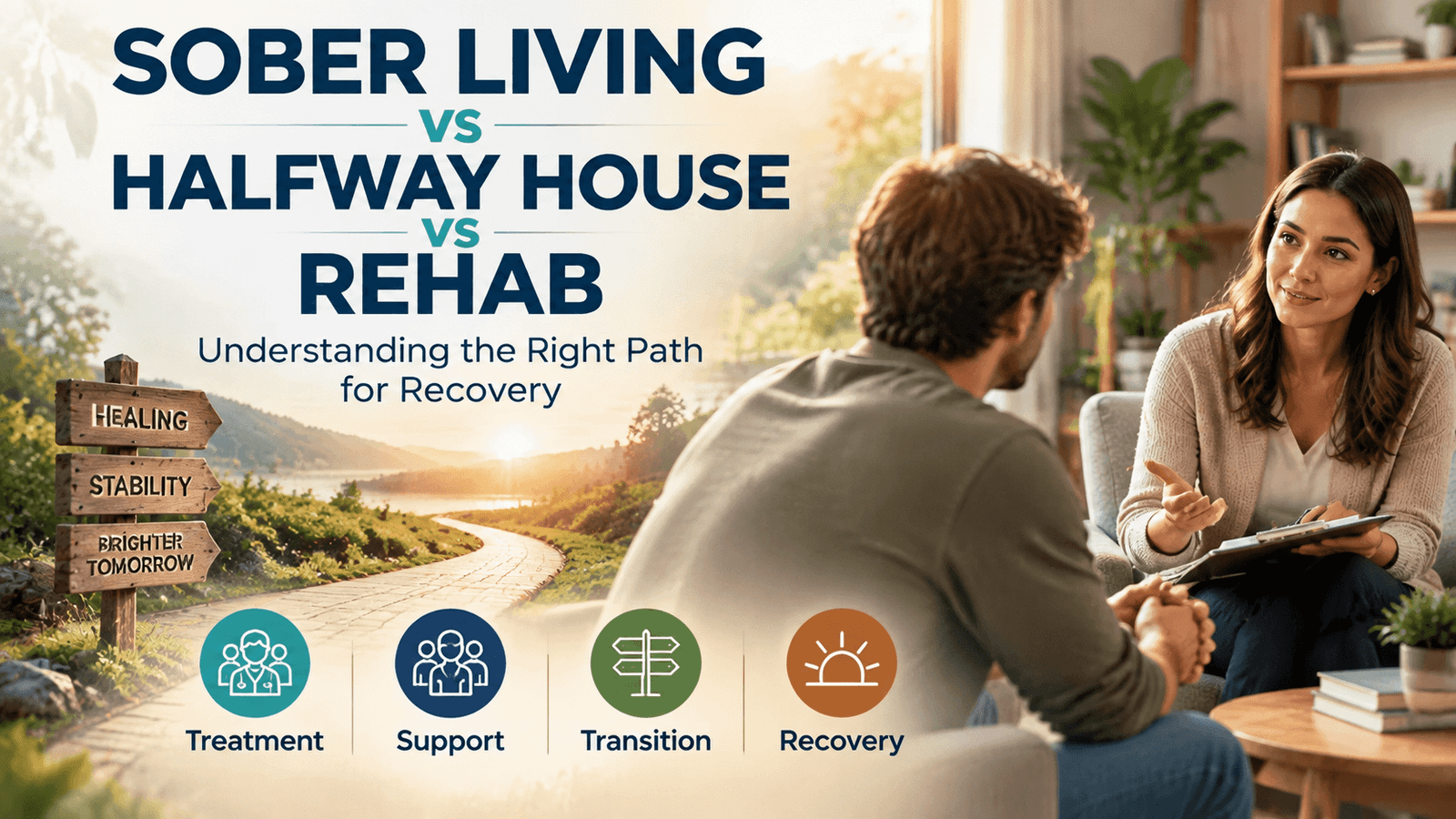
Sober Living vs. Halfway House vs. Rehab: What’s the Difference?
Choosing the right recovery environment can feel confusing, especially when terms such as sober living, halfway house, residential treatment, and rehab are used interchangeably. Understanding sober living vs halfway house is important because these settings can differ significantly in their structure, supervision, treatment services, eligibility, and goals.
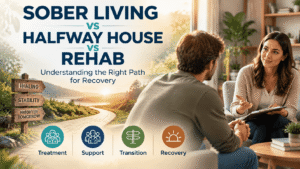
In simple terms, rehab is primarily a treatment setting, while sober living is generally a substance-free living environment designed to support people in recovery. A halfway house can refer to several types of structured transitional housing, and the exact services and rules can vary by program.
SAMHSA describes treatment in several forms, including outpatient, inpatient, and residential care. Recovery housing, meanwhile, is designed around a safe, substance-free living environment and recovery support.
For individuals and families in Houston, understanding these differences can make conversations with treatment providers much more productive.
Sober Living vs Halfway House: What’s the Difference?
The biggest difference between sober living vs halfway house is usually the level and type of structure provided.
Sober living generally refers to recovery housing where residents live in a substance-free environment while building the skills and routines needed for independent living. Residents may work, attend school, participate in counseling, attend recovery meetings, and manage daily responsibilities while living in the home.
A halfway house may provide a more structured transitional environment, sometimes with more supervision, scheduled services, or treatment expectations. However, the term is not used consistently across every community or program.
SAMHSA notes that recovery residences can vary considerably in governance, staffing, and support, ranging from peer-run homes to more supervised and service-intensive residential settings.
That means two facilities using similar terminology may offer very different experiences.
Quick Comparison
Feature | Sober Living | Halfway House | Rehab |
Primary purpose | Recovery-supportive housing | Transitional or structured recovery setting | Active treatment |
Substance-free environment | Usually yes | Usually yes | Usually |
Clinical treatment | May be separate from housing | May or may not be included | Central component |
Supervision | Varies | Typically more structured | Clinical/program supervision |
Daily schedule | Often flexible with house rules | Often more structured | Structured around treatment |
Independent work/school | Common | May be encouraged or required | Depends on program |
Length of stay | Can be flexible | Often transitional | Based on clinical needs |
Medical care | Usually limited or external | Varies | May be available depending on level of care |
The exact model matters more than the label.
What Is a Sober Living House?
A sober living house is a recovery-oriented residence where people can live in a substance-free environment while continuing to develop their recovery skills.
Unlike traditional residential treatment, sober living does not necessarily mean that residents receive clinical therapy in the home itself.
Instead, residents may attend treatment or counseling elsewhere while using the residence as a stable, supportive place to live.
Common expectations can include:
- No alcohol or illicit drug use
- Following house rules
- Paying rent or program fees
- Participating in recovery activities
- Maintaining employment or education
- Respecting other residents
- Following curfew or guest policies where applicable
- Participating in house meetings
SAMHSA defines recovery housing as safe, healthy, family-like, substance-free environments that support individuals recovering from addiction and connect residents with peer support and recovery services.
For many people, stable housing is an important part of continuing recovery.
What Is a Halfway House?
The term halfway house can mean different things depending on the organization, location, and population being served.
Historically, some halfway houses have provided highly structured transitional environments for people leaving intensive treatment, institutions, or correctional settings.
SAMHSA materials describe substance-use-focused halfway houses as potentially more structured than other recovery housing options, sometimes including regularly scheduled treatment, medication management, case management, relapse-prevention work, and restrictions on community activities.
However, not every modern program that calls itself a halfway house operates this way.
Some programs provide mainly housing and accountability, while others offer more intensive services.
That’s why families should ask what a specific facility actually provides rather than relying on its name.
What Is Rehab?
Rehab, short for rehabilitation, generally refers to a treatment program designed to help a person address a substance use disorder and work toward recovery.
Rehab can take different forms.
Inpatient Rehab
Inpatient treatment generally involves staying at a hospital or treatment program overnight.
This level of care may be appropriate for people who require significant medical or clinical support.
Residential Rehab
Residential treatment means living at a treatment program while receiving structured services.
SAMHSA describes residential treatment as care where a person lives at the treatment program, potentially for weeks or months depending on the individual’s needs and the program.
Outpatient Rehab
With outpatient treatment, a person attends scheduled treatment services but lives elsewhere.
Outpatient programs can range from traditional appointments to intensive outpatient or partial hospitalization programs involving several hours of treatment on scheduled days.
Because these levels of care are different, the word «rehab» alone doesn’t tell you how intensive a program is.
Halfway House vs Rehab: What’s the Difference?
The distinction between halfway house vs rehab is primarily about purpose.
Rehab is intended to provide treatment.
A halfway house is generally intended to provide transitional structure, housing, accountability, or recovery support, although some programs may include treatment services.
Think about it this way:
Rehab asks:
«What treatment does this person need?»
Recovery housing asks:
«What environment will help this person maintain recovery while rebuilding daily life?»
Someone may need rehab first and sober living afterward.
Another person may receive outpatient treatment while living in sober housing.
Someone else may need a higher level of clinical care before entering any independent recovery residence.
The appropriate pathway depends on the individual’s clinical and recovery needs.
Can You Go From Rehab to Sober Living?
Yes.
For many people, recovery does not end when formal treatment ends.
After completing a residential or inpatient program, returning immediately to the same environment where substance use occurred may create challenges.
A sober living environment can provide additional structure while a person transitions back into everyday responsibilities.
The individual may:
- Continue therapy
- Attend recovery meetings
- Return to work
- Enroll in school
- Rebuild family relationships
- Practice relapse-prevention skills
- Establish healthy routines
- Develop a sober social network
SAMHSA identifies home and community as two of the major dimensions of recovery and emphasizes stable housing and supportive relationships as important elements of a person’s recovery process.
Do You Need Rehab Before Sober Living?
Not necessarily.
There is no universal rule that every person must complete rehab before entering recovery housing.
Eligibility depends on the residence and the individual’s circumstances.
Some recovery homes are designed for people who are already stable in recovery. Others may accept individuals transitioning directly from treatment, correctional settings, or other environments.
A person experiencing active intoxication, severe withdrawal, an acute medical condition, or serious psychiatric instability may require a higher level of professional care instead of moving directly into independent recovery housing.
This is why an assessment matters.
The question isn’t simply:
«Can I enter sober living?»
It’s:
«What level of care and support do I need right now?»
Sober Living vs Halfway House: Which One Provides Treatment?
This is one of the most important distinctions.
A sober living residence may provide peer accountability, recovery activities, house meetings, transportation support, or connections to outside services, but it may not provide clinical treatment.
Some halfway houses may offer counseling, case management, or other structured services, while others may primarily focus on housing and supervision.
Rehab is specifically designed around treatment.
SAMHSA recommends asking treatment programs about the services they provide, whether they use evidence-based practices, whether providers are licensed or accredited, and how they support a person’s broader needs.
Before choosing any program, ask:
Who provides treatment?
Is a licensed clinician on staff?
Is medical care available?
What happens if withdrawal occurs?
Are medications allowed and managed?
What happens after discharge?
These questions can reveal much more than the program’s marketing language.
How Long Do People Stay in Sober Living?
There is no single universal length of stay.
Some people remain for several months, while others stay longer depending on their recovery needs, finances, housing situation, employment, and program policies.
The purpose is generally not to keep someone dependent on the residence.
Instead, recovery housing can provide a period of stability while residents develop the skills and resources needed for more independent living.
A person’s transition plan may include:
- Stable employment
- Reliable transportation
- Continued treatment
- Healthy relationships
- Independent housing
- Financial planning
- Recovery support
- Relapse-prevention strategies
The right timeline should be based on progress and individual circumstances rather than an arbitrary deadline.
What Rules Are Common in Sober Living?
Rules vary between homes, but many recovery residences establish expectations designed to maintain a safe and supportive environment.
Common rules may involve:
Substance use: Residents must remain free from alcohol and illicit drug use.
Curfews: Some residences establish specific times when residents are expected to return.
Visitors: Homes may have restrictions on visitors to protect the recovery environment.
Employment or school: Residents may be expected to work, attend school, volunteer, or participate in another structured activity.
Meetings and recovery activities: Some programs encourage or require participation in mutual-support meetings or other recovery activities.
House responsibilities: Residents may share chores and community responsibilities.
These rules are not necessarily signs that a program is overly restrictive.
Clear expectations can help create the consistency and accountability many people need during early recovery.
What Should You Look for in a Sober Living Program?
Not all recovery residences operate the same way.
A reputable program should be transparent about its policies, fees, staffing, safety procedures, resident expectations, and connections to treatment.
SAMHSA’s current best-practice guidance emphasizes recovery-centered housing, safe and healthy living environments, peer support, connections to services, and approaches that account for co-occurring mental-health conditions and trauma.
Ask prospective programs:
- What are the admission requirements?
- Is the residence drug and alcohol free?
- Who supervises the home?
- Are staff trained?
- Are random drug screens used?
- What happens after a relapse?
- Can residents take prescribed medications?
- Are mental-health services available?
- Is counseling provided on-site or elsewhere?
- What are the total costs?
- What are the rules about employment and transportation?
- How does discharge or independent living work?
A reputable program should answer these questions clearly.
How Is Sober Living Different From Residential Treatment?
The biggest distinction is the role of clinical treatment.
In residential treatment, the person lives at the treatment facility and receives treatment there.
In sober living, the person lives in a recovery residence and typically connects to treatment and other services separately.
For example, someone might live in a sober living house while attending:
- Outpatient therapy
- Intensive outpatient treatment
- Group counseling
- Medication management
- Recovery meetings
- Individual counseling
This combination can create a bridge between intensive treatment and independent living.
SAMHSA notes that people may need more than one type of treatment or support during recovery.
Can Sober Living Help Prevent Relapse?
A sober living environment can provide several factors that support recovery, including accountability, peer connection, stable housing, and distance from environments associated with substance use.
However, sober living itself is not a guarantee against relapse.
Relapse is influenced by many factors, including substance-use history, mental health, stress, social environment, treatment engagement, and access to recovery support.
Recovery housing works best when it is part of a broader recovery plan rather than treated as a stand-alone solution.
SAMHSA emphasizes that recovery is highly personal and can involve clinical treatment, medications, peer support, family support, self-care, and other pathways.
What About Mental Health and Co-Occurring Disorders?
Addiction and mental-health conditions can occur together.
Someone entering sober living or rehab may also be dealing with:
- Depression
- Anxiety
- PTSD
- Bipolar disorder
- Other mental-health concerns
- Trauma-related symptoms
These concerns should not automatically be treated as separate from recovery planning.
SAMHSA recommends that recovery housing programs account for the prevalence of co-occurring mental-health conditions and trauma among people with substance-use issues and incorporate trauma-informed approaches.
When evaluating a program, ask whether mental-health services are available and how the program responds when residents need additional clinical support.
Which Option Is Right for Someone in Houston?
There is no universal answer.
The appropriate setting depends on factors such as:
- Current substance use
- Withdrawal risk
- Medical needs
- Mental-health symptoms
- Previous treatment
- Home environment
- Family support
- Recovery stability
- Employment or school
- Need for supervision
- Ability to maintain sobriety outside a treatment facility
Someone experiencing significant withdrawal or medical instability may require medical or residential treatment.
Someone who has completed treatment and needs a safe, supportive place to continue recovery may benefit from recovery housing.
Someone who is stable enough to live independently but needs ongoing counseling may be appropriate for outpatient treatment combined with other recovery supports.
The decision should be based on an individualized assessment rather than simply choosing the option that sounds most comfortable.
A Simple Way to Think About the Difference
Here is an easy framework:
Rehab = Treatment
You’re primarily there to receive professional treatment for a substance use disorder.
Halfway House = Transitional Structure
You’re generally living in a structured environment designed to support the transition toward greater independence, although services vary considerably.
Sober Living = Recovery-Supportive Housing
You’re living in a substance-free environment while continuing to build a stable life in recovery, often alongside outside treatment or recovery services.
These categories can overlap.
That is why asking about the actual services, staffing, rules, and level of care is more useful than relying on the label.
Frequently Asked Questions About 7-OH
Sober living generally refers to substance-free recovery housing with peer support, accountability, and house rules. A halfway house can be more structured and may provide transitional or treatment-related services, but definitions vary between programs. SAMHSA describes recovery housing as a range of models differing in staffing and support.
No, although the terms are sometimes used interchangeably. A specific program may use either term while providing services that overlap with the other model. Ask about the facility’s actual rules, supervision, treatment, and recovery services.
Not always. Sober living is generally housing, while rehab is treatment. A person can live in sober housing while attending outpatient therapy or another treatment program.
No universal rule requires everyone to complete rehab first. Admission requirements vary by residence, and a person may need a different level of care depending on medical, psychiatric, withdrawal, and substance-use needs.
Sometimes, but not necessarily. Some halfway houses provide structured treatment or case management, while others focus primarily on transitional housing and accountability.
There is no universal timeline. Length of stay depends on the residence and the individual’s recovery, housing, employment, financial, and support needs.
Many sober living programs allow or encourage employment, education, volunteering, or other structured daytime activities. Specific rules vary by residence.
Residential treatment combines living at the program with structured clinical treatment. Sober living primarily provides a substance-free recovery environment, with treatment often occurring separately.
Families should ask about safety, staffing, licensing or accreditation where applicable, substance-use policies, drug testing, medications, mental-health support, costs, transportation, treatment connections, and what happens if a resident returns to use.
Choosing the Next Step in Recovery
The decision between rehab, a halfway house, and sober living is not simply about choosing a building.
It’s about finding the right level of support for the person’s current stage of recovery.
For some people, that may mean medically supervised or residential treatment.
For others, it may mean outpatient care combined with a stable recovery residence.
For someone who has completed intensive treatment, sober living may provide the structure and community needed while they rebuild everyday life.
There is no shame in needing more support.
Recovery is a process, and different stages may require different kinds of help.
At Winds of Change Counseling & Recovery, the focus is on meeting individuals where they are and helping them move toward healthier, more sustainable recovery. Professional assessment can help determine what level of care and support makes sense for an individual’s circumstances.
The right next step is the one that provides an appropriate level of safety, treatment, accountability, and support.