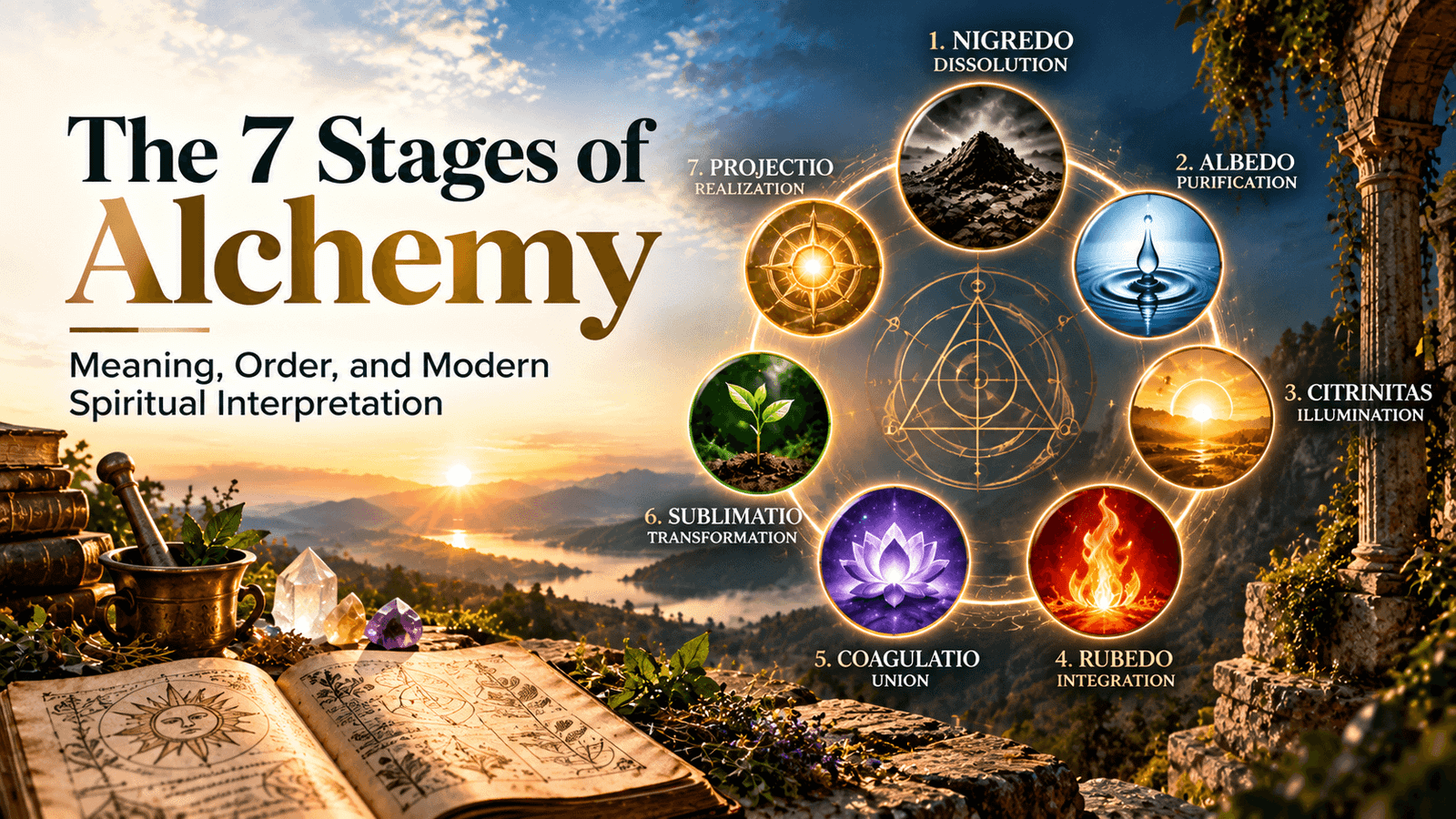
The 7 Stages of Alchemy are commonly understood today as a symbolic framework for transformation, self-discovery, and spiritual growth. Drawing on the traditional alchemical operations of calcination, dissolution, separation, conjunction, fermentation, distillation, and coagulation, modern interpretations describe a journey from breaking down old patterns to developing greater clarity, balance, and integration. However, historical alchemy did not follow one universal sequence, and the seven operations should not be confused with the four traditional color stages of the alchemical Great Work.
In modern spiritual discussions, alchemy is often used as a metaphor for turning difficult experiences into opportunities for learning and personal change. Understanding its historical roots makes it easier to explore these interpretations without treating symbolic beliefs as established scientific facts.
What Are the 7 Stages of Alchemy?
The 7 Stages of Alchemy are most commonly presented in modern spiritual interpretations as seven operations that describe different aspects of transformation. Historically, alchemists used operations involving heat, liquids, separation, combination, fermentation, distillation, and solidification in their attempts to understand and transform materials.
The seven operations are:
- Calcination: Breaking down an existing form.
- Dissolution: Softening rigid structures and allowing change.
- Separation: Distinguishing useful or essential elements from unwanted ones.
- Conjunction: Bringing complementary elements together.
- Fermentation: Introducing the possibility of renewal and new growth.
- Distillation: Refining and clarifying what remains.
- Coagulation: Giving the transformed result a stable form.
In a modern spiritual reading, these operations can provide a language for reflecting on personal development. Someone might interpret calcination as questioning old beliefs, separation as identifying healthier choices, and coagulation as putting new insights into everyday practice.
Important historical note: These seven operations are not the only model of alchemical transformation. Different authors and traditions used different numbers and sequences. The operations also should not be presented as a fixed, universally accepted psychological process.
Why Does Alchemy Symbolize Transformation?
Alchemy developed across several historical and cultural settings, involving practical work with materials as well as philosophical, religious, and symbolic ideas. Its practitioners explored the transformation of substances, including attempts to produce precious metals and discover substances believed to have extraordinary properties.
The term Magnum Opus, meaning “Great Work,” became associated with the alchemical project of transformation toward an ideal result. In modern spiritual writing, this imagery is frequently interpreted as a metaphor for human change: the process of examining old patterns, developing awareness, and integrating new understanding.
Psychologist Carl Gustav Jung later interpreted alchemical imagery as a symbolic language for aspects of psychological development and individuation. His interpretation is influential, but historians have also questioned whether Jung’s psychological framework accurately represents the intentions of historical alchemists. The historical and modern psychological interpretations should therefore be understood as related but distinct perspectives.
The Seven Operations of Alchemy Explained
1. Calcination: Breaking Down Old Structures
Calcination traditionally refers to heating a material until it undergoes a substantial physical change, often leaving a residue or ash.
Modern spiritual interpretation: Calcination can symbolize the moment when familiar beliefs, identities, or expectations are challenged. An experience may reveal that an old way of thinking no longer fits the person you are becoming.
For example, someone might recognize that constantly seeking other people’s approval is preventing them from making decisions based on their own values. That realization may be uncomfortable, but it can create room for change.
Reflection question: Which beliefs or expectations no longer reflect the person I want to become?
The purpose of this interpretation is not to glorify suffering. Difficult experiences do not automatically lead to growth, and nobody has to experience a crisis to begin changing.
2. Dissolution: Allowing Change to Begin
In laboratory alchemy, dissolution involves a substance dissolving in a liquid. Symbolically, it can represent a period when previously firm structures become less certain.
Modern spiritual interpretation: Dissolution can describe the willingness to question familiar assumptions and remain open to new possibilities. It may involve recognizing emotions that have been ignored or reconsidering patterns that once felt permanent.
For instance, someone who has always believed they must handle every problem alone might begin to recognize the value of asking trusted people for support.
This stage invites flexibility rather than the need to have every answer immediately.
Reflection question: What might become possible if I allowed myself to approach this situation differently?
3. Separation: Distinguishing What Matters
Separation is an alchemical operation in which components are distinguished or separated from a mixture.
Modern spiritual interpretation: Separation can represent discernment—the ability to examine habits, influences, commitments, and relationships and decide which ones support your values.
This does not mean judging everything in life as either good or bad. It means becoming more aware of consequences and making choices with greater intention.
A person might discover that certain routines increase stress, while others support rest, healthy relationships, and personal goals.
Reflection question: Which habits and influences support my well-being, and which ones may be holding me back?
4. Conjunction: Bringing Opposites Into Balance
Conjunction refers to the joining of elements that have been separated or transformed. In alchemical symbolism, this union can represent the creation of something different from the original components.
Modern spiritual interpretation: Conjunction can symbolize integrating parts of life that seem to conflict. Strength and vulnerability, independence and connection, or ambition and rest can sometimes be understood as complementary qualities rather than opposing forces.
For example, a person may learn that setting boundaries does not prevent them from caring about others. Both compassion and self-respect can exist together.
The goal is not to eliminate every contradiction. It is to develop a more balanced understanding of oneself.
Reflection question: Which parts of myself have I treated as incompatible that might actually work together?
5. Fermentation: Making Room for Renewal
Fermentation refers to processes through which a substance changes, including changes associated with decomposition and the emergence of new properties.
Modern spiritual interpretation: Fermentation can symbolize renewal after a period of questioning or change. New insights begin to take root, and a person may find a different source of motivation or a healthier sense of direction.
This process may be gradual. New habits often require practice before they become part of everyday life.
A person might begin replacing avoidance with honest conversations, creating consistent routines, or learning to ask for help when needed.
Reflection question: What new perspective or habit am I ready to nurture?
6. Distillation: Refining Understanding
Distillation traditionally involves heating a mixture and collecting vapor or condensate to separate and refine components.
Modern spiritual interpretation: Distillation can symbolize reviewing experience, clarifying priorities, and distinguishing lasting lessons from temporary reactions.
Rather than assuming every experience contains a hidden message, a person can ask what they learned, what evidence supports their conclusions, and what they would approach differently next time.
Practices such as journaling, meditation, thoughtful discussion, and reflection may help people organize their thoughts, although their benefits depend on the individual and the practice.
Reflection question: What have my experiences taught me, and which lessons do I want to carry forward?
7. Coagulation: Integrating Change Into Daily Life
Coagulation traditionally refers to bringing a substance into a more fixed or solid form. In alchemical symbolism, it can represent the completion or stabilization of the Great Work.
Modern spiritual interpretation: Coagulation symbolizes turning insight into consistent action. Recognizing a healthier approach is one thing; practicing it in daily life is another.
For example, a person who values emotional well-being might begin maintaining boundaries, seeking support when necessary, and building routines that reflect those priorities.
Transformation becomes meaningful when it influences how a person lives, not merely what they understand intellectually.
Reflection question: What practical action would help me live according to what I have learned?
The Four Traditional Color Stages of Alchemy
The seven operations are often discussed alongside a different framework: the four color stages of the alchemical Great Work. These stages are known by their Latin names and are commonly associated with black, white, yellow, and red.
Although modern interpretations sometimes map these stages onto a journey of personal or spiritual transformation, they emerged from historical alchemical traditions involving material processes and changing colors. Their historical meanings were not always identical across writers and periods.
Nigredo: The Blackening
Nigredo refers to blackening. In modern symbolic interpretation, it is often associated with breakdown, uncertainty, confrontation with difficult truths, or the recognition that an old structure no longer works.
Albedo: The Whitening
Albedo refers to whitening. Symbolically, it is frequently associated with purification, clarity, reflection, or the process of distinguishing what matters from what does not.
Citrinitas: The Yellowing
Citrinitas refers to yellowing. In modern spiritual interpretations, it can represent the emergence of insight, illumination, or a new perspective. Its place in the historical tradition varied, and some later accounts emphasized three main color stages rather than four.
Rubedo: The Reddening
Rubedo refers to reddening. Symbolically, it is commonly associated with completion, integration, or the realization of the Great Work.
These color stages are an important complement to the seven operations, but they should not be treated as seven additional steps or combined with the operations into one universal sequence.
What Is the Meaning of the 7 Stages of Alchemy in Modern Spirituality?
The modern spiritual interpretation of alchemy often centers on the idea that transformation involves more than replacing one habit with another. It may require questioning old assumptions, acknowledging difficult emotions, clarifying values, and putting new understanding into practice.
Viewed symbolically, the operations offer several themes:
- Awareness: Recognizing patterns that need attention.
- Acceptance: Acknowledging reality without pretending that difficulties do not exist.
- Discernment: Deciding which habits and influences support personal values.
- Integration: Bringing new insights into relationships and everyday decisions.
- Consistency: Maintaining practical changes over time.
This interpretation can be useful as a reflective framework, but it is not a scientific law or a universal map of human development. People change in different ways and at different speeds. They may revisit earlier questions, make progress in one area while struggling in another, or find that their experience does not resemble the alchemical imagery at all.
Can Spiritual Alchemy Help With Personal Growth?
Some people find symbolic frameworks helpful because they provide language for describing experiences that can otherwise feel difficult to organize.
The idea of transformation may encourage a person to reflect on questions such as:
- What patterns do I want to change?
- What values matter most to me?
- Which relationships support my growth?
- Where do I need better boundaries?
- What habits would make my daily life healthier?
- What support would help me follow through?
Spiritual reflection can be one part of a broader approach to personal growth. It can coexist with education, practical planning, community support, counseling, and other approaches suited to an individual’s needs.
The important distinction is that symbolism can help people explore meaning, but it cannot guarantee a particular outcome.
The Connection Between Alchemy and Jungian Psychology
Carl Gustav Jung interpreted alchemical symbols as a way to explore psychological development. One of the central concepts in Jungian psychology is individuation, a process associated with developing a more integrated relationship with different aspects of the psyche.
From this perspective, alchemical imagery can be read as a symbolic representation of confronting inner conflicts and becoming more aware of patterns that were previously difficult to recognize.
However, this is a modern psychological interpretation of historical material, not proof that alchemists originally intended their laboratory work to describe the same psychological process.
Historians have emphasized the importance of understanding the historical context of alchemical texts rather than treating them all as coded psychology. If you explore alchemy through a Jungian lens, it is helpful to identify that lens clearly and distinguish it from the historical study of alchemy.
Can the 7 Stages of Alchemy Be Applied to Recovery?
The stages and operations of alchemy are sometimes used metaphorically to talk about change, resilience, and renewal. In that limited sense, their themes may prompt reflection on the process of building a healthier life.
For example, someone could use the idea of separation to think about which environments support their goals, or use coagulation as a reminder to turn intentions into consistent routines.
However, the 7 Stages of Alchemy are not a clinical addiction-treatment model, and there is no established evidence that following them treats substance use disorder.
Recovery may involve professional assessment, counseling, medical care, prescribed medication where appropriate, peer support, and changes in daily routines. The right plan depends on the individual’s needs and circumstances.
Spiritual practices can be meaningful for some people, but they should complement rather than replace appropriate professional treatment. No one needs to interpret every hardship as a necessary stage of transformation, and recovery does not require spiritual beliefs.
How to Use the Seven Operations as a Reflection Exercise
If the symbolism resonates with you, you can use the seven operations as a series of optional journaling prompts.
Step 1 — Calcination: Identify one belief or habit you want to examine.
Step 2 — Dissolution: Consider what new information or perspective you may need to acknowledge.
Step 3 — Separation: Identify which choices support your values and which choices work against them.
Step 4 — Conjunction: Look for two needs or priorities that could be balanced rather than treated as opposites.
Step 5 — Fermentation: Choose one new behavior or perspective you would like to develop.
Step 6 — Distillation: Reflect on what you have learned and what remains uncertain.
Step 7 — Coagulation: Choose one realistic action to practice consistently.
Keep the exercise flexible. You can revisit questions, skip prompts that do not feel useful, and seek support when reflection brings up distressing experiences. There is no need to force yourself through a rigid sequence.
Frequently Asked Questions About the 7 Stages of Alchemy
A common modern seven-operation sequence is calcination, dissolution, separation, conjunction, fermentation, distillation, and coagulation. Historical alchemical texts used varied models, so this should not be presented as the single universal sequence used by all alchemists.
In modern interpretations, calcination represents breaking down old structures; dissolution, allowing change; separation, discernment; conjunction, integration; fermentation, renewal; distillation, refinement; and coagulation, putting change into practice. These are symbolic interpretations, not scientifically established stages of personal development.
No. The seven operations and the four color stages are separate frameworks. The four color stages are nigredo (blackening), albedo (whitening), citrinitas (yellowing), and rubedo (reddening).
Historical alchemy involved material experimentation, natural philosophy, and religious or philosophical ideas that differed across times and places. Spiritual alchemy is a modern umbrella term for interpretations that use alchemical processes as metaphors for inner transformation.
No. Alchemical traditions existed long before Jung. He developed influential psychological interpretations of alchemical symbols, especially in relation to individuation, but he did not invent historical alchemy or establish one universally accepted seven-stage system.
They can serve as optional prompts for reflection on change and personal values. They are not a validated recovery protocol and should not replace evidence-based addiction treatment, medical guidance, counseling, or other appropriate support.
Not necessarily. The seven-operation sequence is a framework for understanding alchemical work, not a universal law of human development. Real-life change is often uneven and may involve revisiting challenges or taking different paths.
Conclusion: Transformation as an Ongoing Practice
The 7 Stages of Alchemy offer a symbolic way to explore breaking down old structures, developing clarity, combining new perspectives, and putting change into practice. Their historical roots are complex, and different alchemical writers did not all follow the same model.
For modern readers, the value of spiritual alchemy lies in thoughtful interpretation rather than rigid rules. Its imagery can prompt useful questions about values, habits, relationships, and personal growth, while leaving room for individual differences and real-world support.
Transformation does not have to be dramatic or mysterious. Sometimes it begins with recognizing a pattern, asking for help, setting a boundary, or taking one practical step in a healthier direction.
Use the symbolism if it helps you reflect, stay grounded in what is useful, and remember that meaningful change is built through choices and support over time.